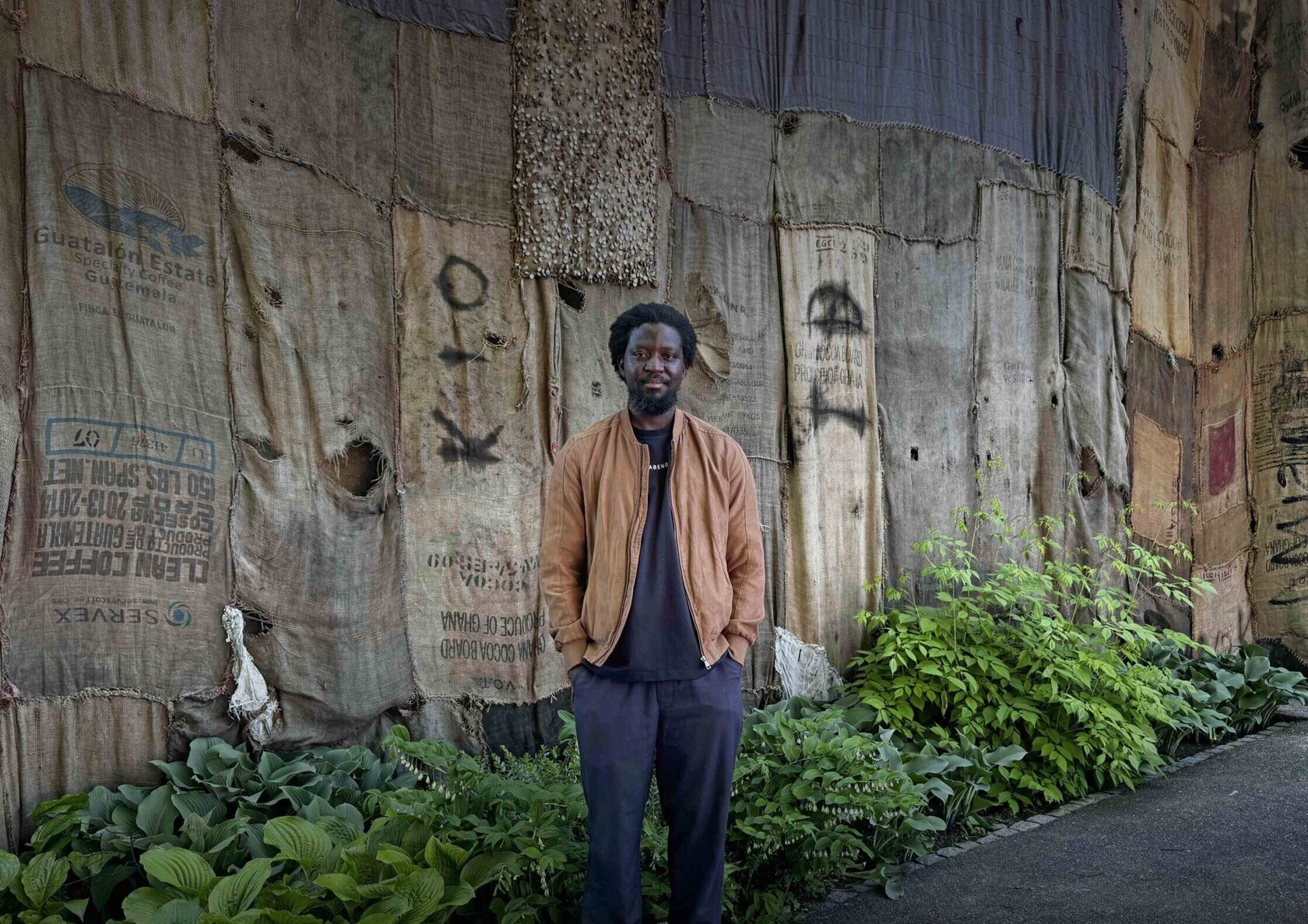
On April 30, 2025, Kunsthalle Bern — Switzerland’s oldest contemporary art museum — unveiled a monumental outdoor intervention by Ghanaian artist Ibrahim Mahama. Known for his critical use of found materials, Mahama has enveloped the museum’s entire exterior in used jute sacks, creating a site-specific installation that simultaneously references and reinterprets the historic 1968 wrapping of the building by Christo and Jeanne-Claude.
While the earlier project explored the ephemerality of art through industrial plastic, Mahama reactivates the gesture with new urgency. His use of jute — a material embedded with histories of labor, trade, and decay — opens a dialogue on colonial legacies, ecological impact, and global inequality.
While the earlier project explored the ephemerality of art through industrial plastic, Mahama reactivates the gesture with new urgency. His use of jute — a material embedded with histories of labor, trade, and decay — opens a dialogue on colonial legacies, ecological impact, and global inequality.
Material as Archive
In Mahama’s hands, the jute sack becomes a document — a worn, marked, and weathered record of systems often left unseen:
“These sacks are not just material; they bear the marks of thousands of hands that remain unseen,” — Ibrahim Mahama
If Christo and Jeanne-Claude once wrapped the Kunsthalle to explore the boundaries of form, Mahama’s intervention functions as a layer of historical memory, inviting viewers to confront the complex and often obscured consequences of global capitalism.
- Disaster Capitalism: These sacks, circulated globally, track the relentless rhythm of extraction — from cocoa to coal — until they degrade. Each bears the imprint of a transactional economy and its devastating environmental toll.
- Ecological Disruption: Up to 40% of cocoa crops are lost to pests such as the cocoa moth. Traces of these insects — often visible on the sacks — become symbols of nature disrupting industrial processes, slowing the machinery of overproduction.
- Colonial Continuities: Mahama confronts the still-active trade networks between Ghana and Europe. While cocoa is harvested under precarious labor conditions, the profits accumulate far from the source — in countries like Switzerland, home to the global chocolate industry.
“These sacks are not just material; they bear the marks of thousands of hands that remain unseen,” — Ibrahim Mahama
If Christo and Jeanne-Claude once wrapped the Kunsthalle to explore the boundaries of form, Mahama’s intervention functions as a layer of historical memory, inviting viewers to confront the complex and often obscured consequences of global capitalism.
On View Through June 1, 2025
Mahama’s installation will remain in place until the completion of restoration work at Kunsthalle Bern. For further details, visit the official museum website.
About the Artist
Born in 1987 in Tamale, Ghana, Ibrahim Mahama is internationally acclaimed for his large-scale installations utilizing repurposed materials — particularly jute sacks formerly used to transport commodities like cocoa, rice, and charcoal. He began working with these materials in 2011, inspired by the unequal mobility of goods and people across Ghana’s borders.
Mahama’s work has been presented at the Venice Biennale (2015, 2019), Documenta 14 (2017), and the Sharjah Biennial (2023). Solo exhibitions include the Barbican Centre (London), Kunsthalle Osnabrück (Germany), and the Tel Aviv Museum of Art (Israel).
This latest project continues his examination of invisible labor and postcolonial entanglements, linking the global commodity chain — and its costs — to architectural space. The jute sacks used in the installation were once carriers of cocoa, a crop introduced to Ghana by Basel missionaries in 1857, which remains a pillar of the Swiss chocolate industry today.
Kunsthalle Bern, Switzerland | April 30 — June 1, 2025
Mahama’s work has been presented at the Venice Biennale (2015, 2019), Documenta 14 (2017), and the Sharjah Biennial (2023). Solo exhibitions include the Barbican Centre (London), Kunsthalle Osnabrück (Germany), and the Tel Aviv Museum of Art (Israel).
This latest project continues his examination of invisible labor and postcolonial entanglements, linking the global commodity chain — and its costs — to architectural space. The jute sacks used in the installation were once carriers of cocoa, a crop introduced to Ghana by Basel missionaries in 1857, which remains a pillar of the Swiss chocolate industry today.
Kunsthalle Bern, Switzerland | April 30 — June 1, 2025
Contributor: Daria Neuhaus
Сover: Daria Neuhaus