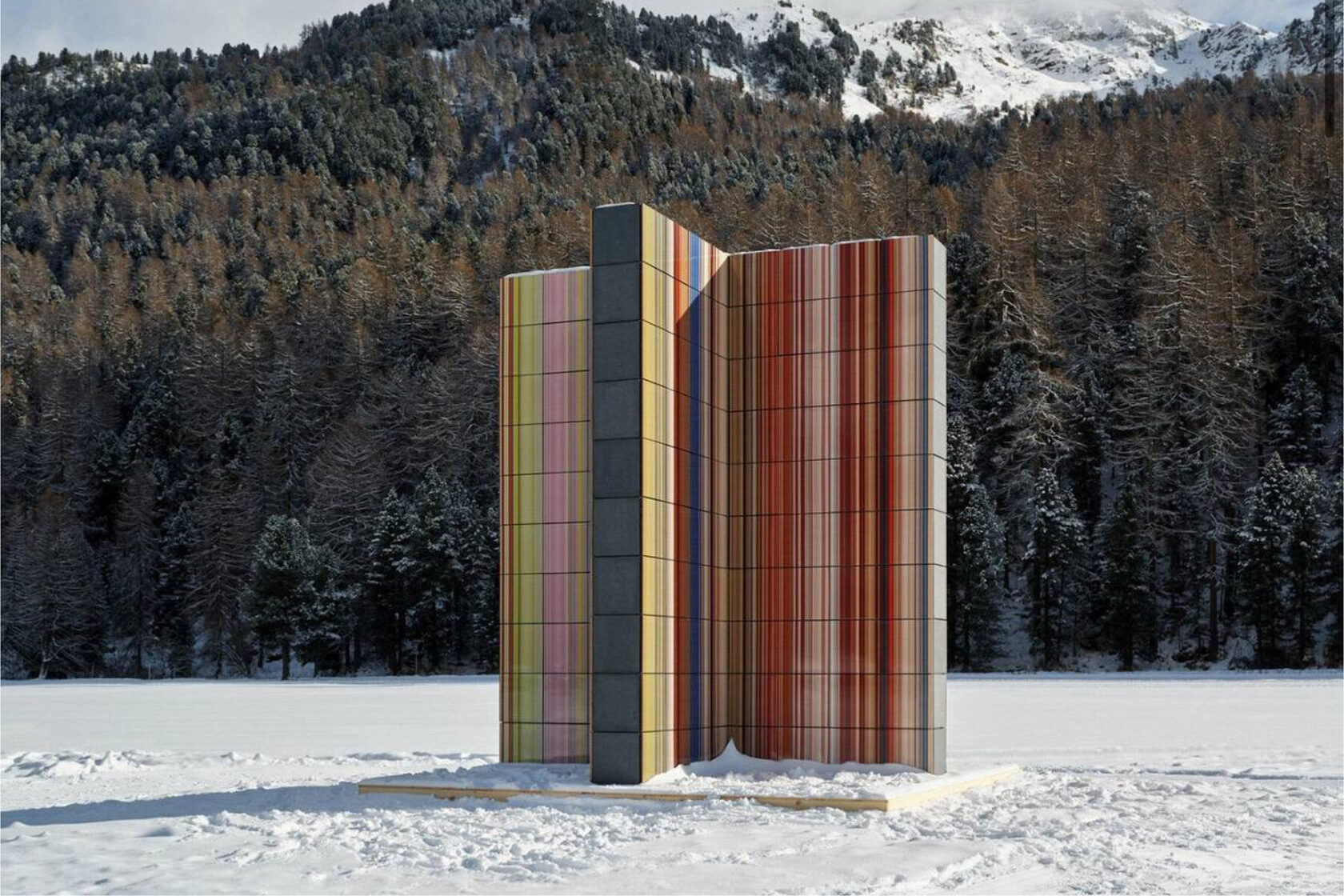
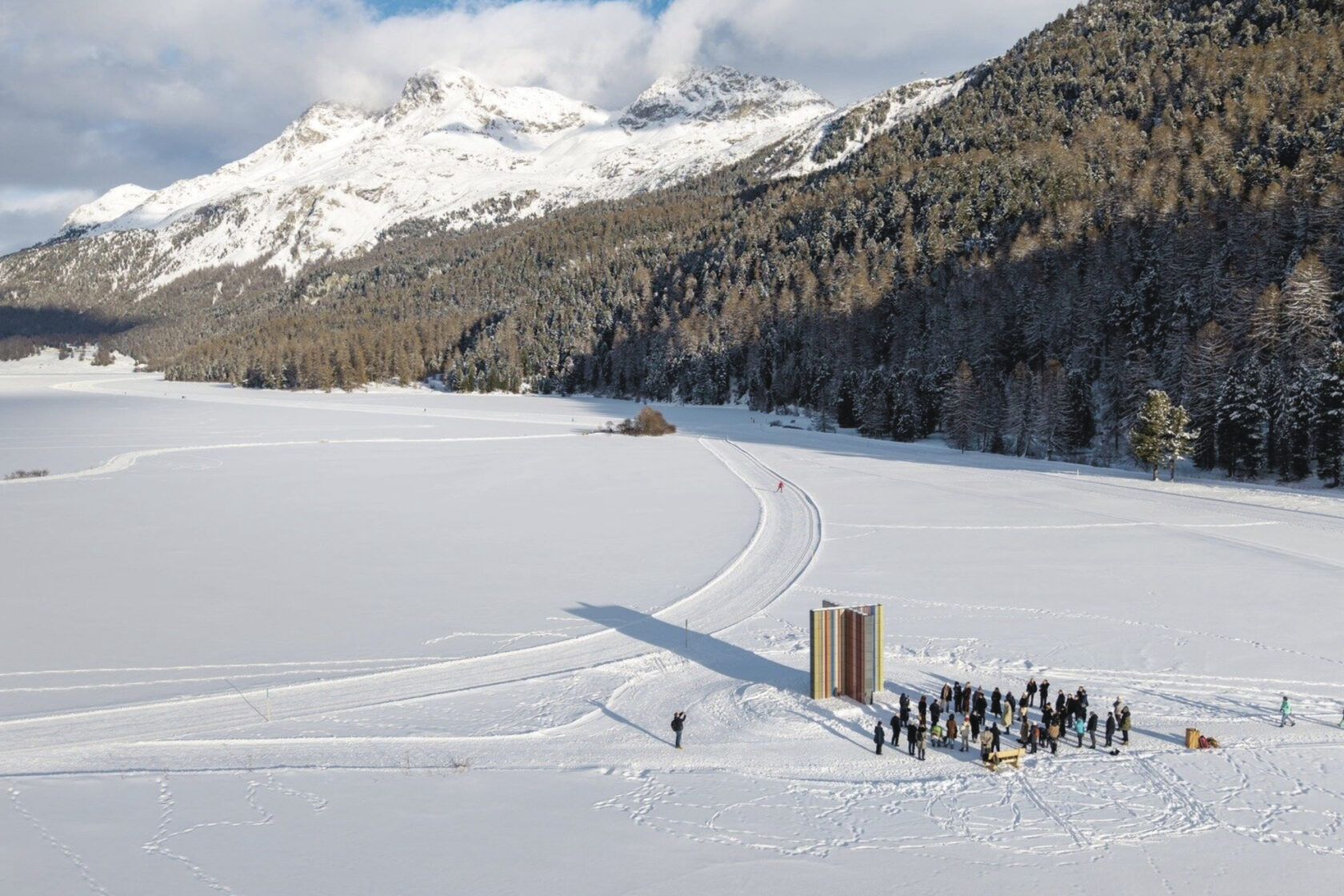
In the breathtaking Swiss Engadine region, where the serene Lake Silvaplana mirrors the alpine sky, a striking new landmark has emerged. Gerhard Richter’s Strip Tower now stands on the shores near the village of Sils‑Maria, inviting visitors into a multisensory encounter with contemporary art.
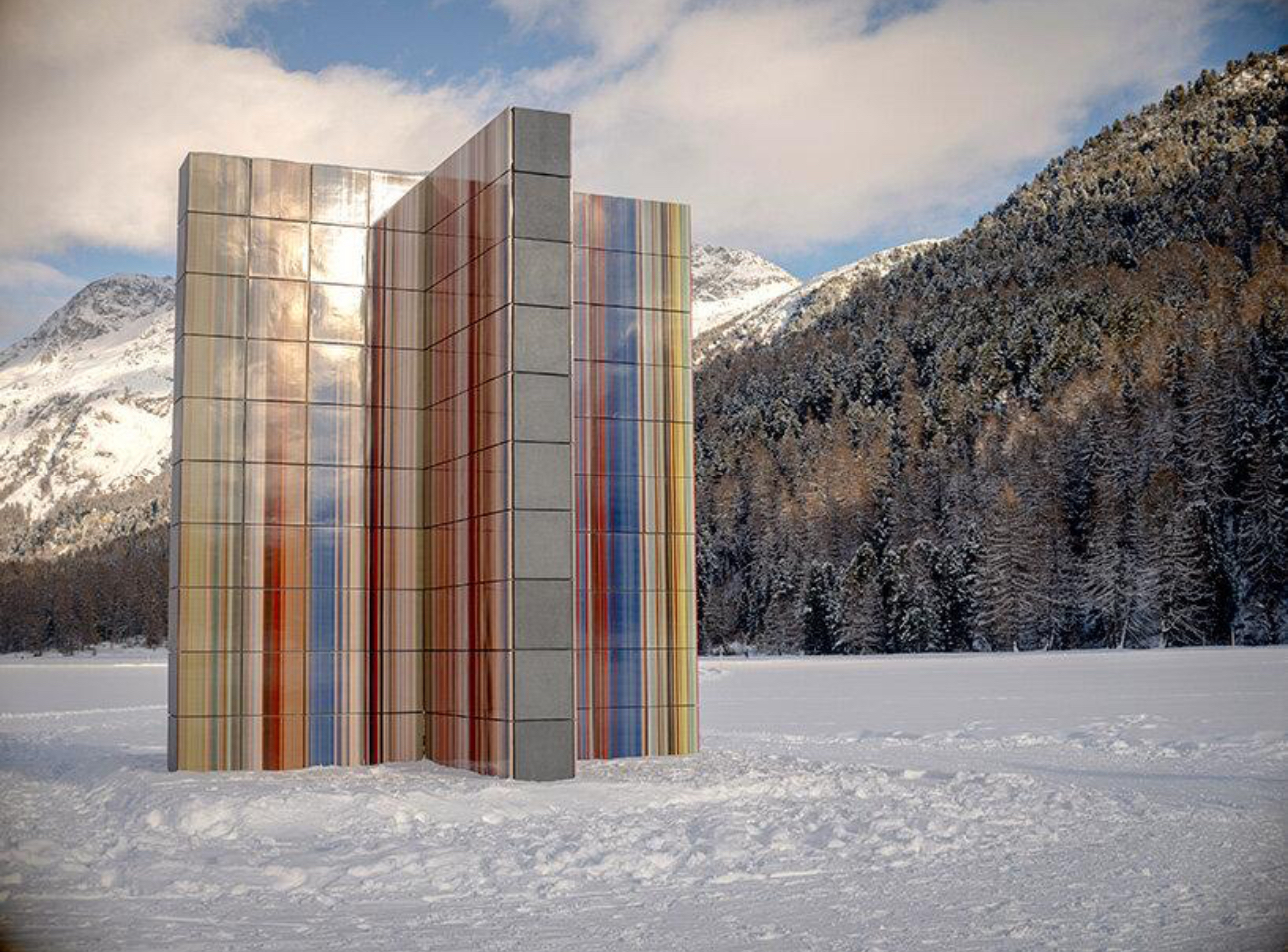
The five‑metre‑tall sculpture consists of eight perpendicular panels clad in glazed ceramic tiles. Each panel displays vivid vertical stripes that seem to pulse with rhythmic energy. They form a cross‑shaped interior space: a deliberate invitation for viewers to step inside and experience abstraction not just visually, but physically. This transformation of a flat pattern into inhabitable architecture marks a bold evolution of Richter’s long‑standing artistic inquiry.
Strip Tower draws directly from Richter’s Strip Paintings series, which he began developing in 2010. The process starts in the studio. Richter paints an abstract composition, then photographs and scans it. Using digital tools, he dissects the image into fine fragments, stretches them, and reassembles the parts. Through this chain of transformations, the original brushstroke metamorphoses into a system of colour bands where repetition and chance coexist in balance. In the Tower, this method breaks free from the canvas, taking on a three‑dimensional, architectural form.
The work also echoes earlier explorations by the artist, such as the kaleidoscopic 4900 Colours, where Richter probed the boundaries of perception, order, and control. Before its arrival in the Swiss Alps, the installation was on view in London’s Kensington Gardens, demonstrating the universal resonance of Richter’s visual language.
The work also echoes earlier explorations by the artist, such as the kaleidoscopic 4900 Colours, where Richter probed the boundaries of perception, order, and control. Before its arrival in the Swiss Alps, the installation was on view in London’s Kensington Gardens, demonstrating the universal resonance of Richter’s visual language.
The project in Switzerland comes to life through the initiative of the LUMA Foundation as part of its Elevation 1049 programme, launched in 2014. This long‑term effort treats the Alps as a dynamic field for artistic experimentation, situating site‑specific works within the landscape. Richter’s installation fits the local context with particular poignancy: the artist first visited Sils‑Maria in 1989 and has returned regularly ever since, drawn to a place steeped in cultural history.
Gerhard Richter, born in 1932, remains one of the most celebrated and valuable artists of our time. His oeuvre spans styles from photorealism and pop art to abstraction and conceptualism. In 1972, he became the first artist to represent West Germany solo at the Venice Biennale. Today, his works reside in major museums worldwide, and retrospectives have triumphed at institutions like Tate Modern in London and MoMA in New York. Notably, until 2 March 2026, the largest retrospective of his career unfolds at the Fondation Louis Vuitton in Paris, further cementing his legacy as a visionary of modern art.
Visitors will be able to explore Strip Tower until spring 2029, offering ample time to experience this fusion of art, architecture, and alpine tranquillity.
Contributor: Maria Efimova
Cover photo: Gerhard Richter. Strip Tower © Photo: Schaub Stierli. Provided by Gerhard Richter Kunststiftung and Luma Foundation Fotografie